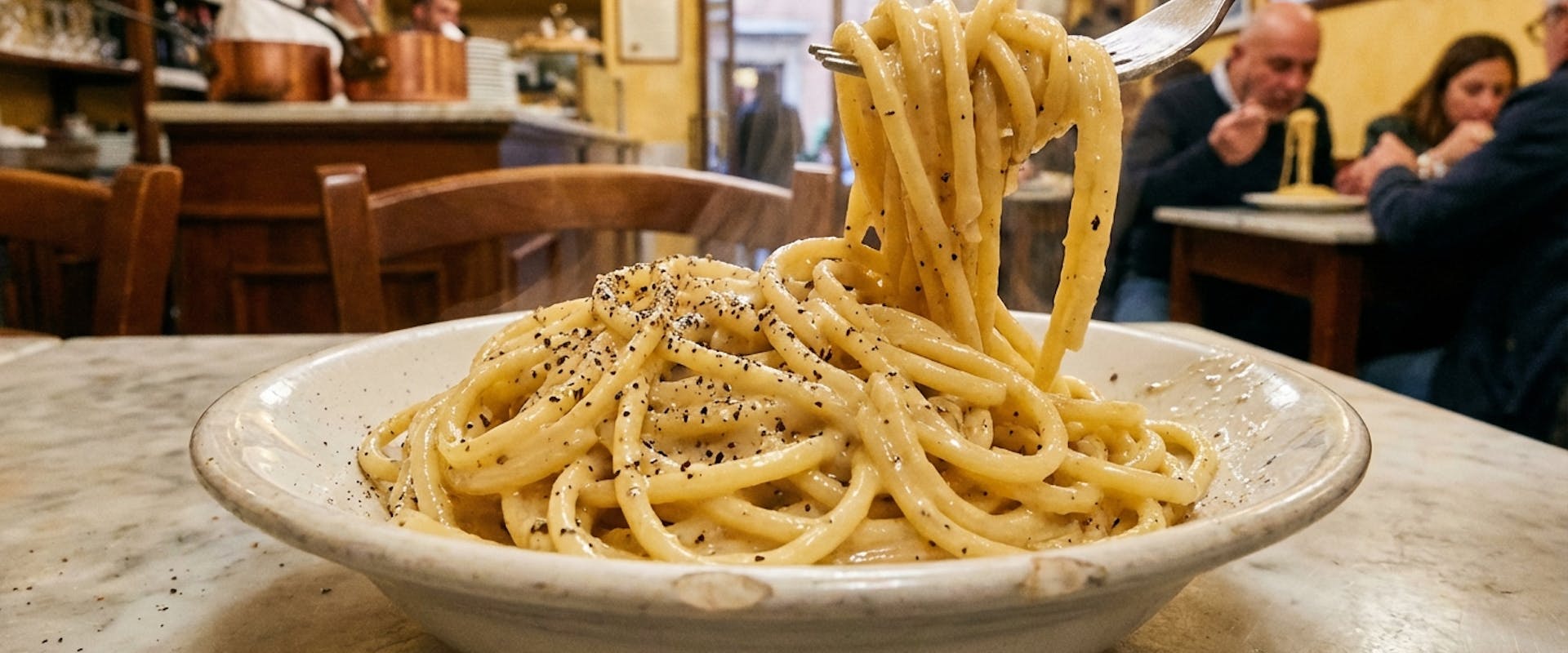

Midnight in Rome: The Three-Ingredient Miracle of Cacio e Pepe
The clock strikes midnight at Flavio al Velavevodetto, and the kitchen shows no signs of slowing. In a corner of Testaccio—Rome's former slaughterhouse district turned culinary mecca—a line cook performs a ritual that has repeated nightly for generations. Three ingredients. Two minutes. One perfect plate of cacio e pepe.
I watch as he tosses tonnarelli in a pan with nothing but pasta water, grated pecorino romano, and coarsely ground black pepper. The sauce emulsifies before my eyes, transforming from separate elements into glossy, unified perfection. It looks like alchemy. It tastes like Rome itself.
The Holy Trinity of Simplicity
Cacio e pepe—literally "cheese and pepper"—belongs to Rome's quartet of essential pasta dishes, alongside carbonara, amatriciana, and gricia. But where the others allow for slight variations or additional ingredients, cacio e pepe demands purity. Three ingredients. No cream. No butter. No shortcuts.
This simplicity is deceptive. Ask any chef, and they'll tell you: cacio e pepe is one of the most technically demanding dishes in Italian cuisine. The margin for error is razor-thin. Too hot, and the cheese clumps into grainy disaster. Too much water, and you have soup. Too little, and you have dry pasta with cheese powder.
Yet Romans have been perfecting this dish for centuries, and in the right hands, those three humble ingredients transcend their parts.
The Pecorino Principle
Not all cheese is created equal, and in Rome, there is no substitute for pecorino romano. This sheep's milk cheese, aged for a minimum of eight months, carries a sharp, salty punch that younger cheeses cannot match.
At Antica Caciara Trasteverina, a cheese shop that has supplied Rome's restaurants since 1900, I learn to identify the real thing. True pecorino romano bears the DOP stamp—Denominazione di Origine Protetta—guaranteeing it was made in specific regions of Lazio, Sardinia, or Grosseto using traditional methods.
The shopkeeper, whose family has sold cheese here for four generations, grates a sample for me to taste. The flavor is complex: nutty, tangy, with a crystalline texture that dissolves on the tongue. This is the cheese that will make or break your cacio e pepe.
The Pepper Philosophy
Black pepper in cacio e pepe isn't seasoning—it's a starring ingredient. Romans use Tellicherry peppercorns or similar high-quality varieties, coarsely ground just before cooking. The pepper should be visible in the finished dish, providing bursts of heat that play against the rich cheese.
At Roscioli, perhaps Rome's most celebrated restaurant-deli hybrid, the chef shows me his technique. He toasts whole peppercorns in a dry pan until fragrant, then crushes them roughly with a mortar and pestle. The aroma that rises is floral and complex, nothing like pre-ground pepper from a jar.
"The pepper must taste alive," he explains. "Old pepper tastes like dust. Fresh pepper tastes like the sun."
A Recipe to Remember
Cacio e Pepe (Roman-Style Cheese and Pepper Pasta)
Ingredients:
- 400g dried pasta (tonnarelli, rigatoni, or thick spaghetti)
- 200g pecorino romano, finely grated (use a microplane)
- 2 tablespoons whole black peppercorns, coarsely ground
- Salt for pasta water
Equipment:
- Large pot for boiling pasta
- Large sauté pan
- Tongs or pasta fork
- Microplane or fine grater
Method:
Bring a large pot of water to a rolling boil. Salt it generously—the water should taste like the sea. Romans don't measure salt; they taste.
While water heats, toast peppercorns in a dry pan over medium heat for one to two minutes until fragrant. Remove from heat and coarsely grind using a mortar and pestle or spice grinder. You want texture, not powder.
Grate pecorino romano on the finest setting of your microplane. Work quickly before it dries out.
Cook pasta until two minutes before package instructions suggest. It should still have significant bite—it will finish cooking in the pan.
Two minutes before pasta is ready, heat your largest sauté pan over medium heat. Add half the ground pepper and toast for thirty seconds until it releases its perfume.
Using a spider or tongs, transfer pasta directly from boiling water to the sauté pan—do not drain. The pasta water clinging to the noodles is essential. Add one cup of pasta cooking water to the pan.
Toss pasta vigorously for one minute over medium heat. The starch will begin to thicken the water into a light sauce.
Remove pan completely from heat. This is critical—the pan must not be hot when you add cheese, or it will clump.
Sprinkle half the pecorino over the pasta while tossing continuously with tongs. Add the remaining cheese while still tossing. The motion is crucial—you're emulsifying, not melting.
If the sauce looks tight or dry, add pasta water one tablespoon at a time while tossing. If it looks too loose, let it rest for twenty seconds—the sauce will tighten as it cools.
The pasta is ready when the sauce is creamy and glossy, coating each strand evenly. It should flow slowly, like heavy cream, not cling like glue.
Plate immediately. Garnish with remaining pepper on top. Serve in warm bowls.
Eat immediately while the sauce is still molten. Cacio e pepe waits for no one.
Roman Wisdom:
- The pasta water is not just water—it's liquid starch that creates the emulsion. Never skip it.
- Remove the pan from heat before adding cheese. This is the most common mistake. Hot pan = broken sauce.
- Toss constantly while adding cheese. The motion creates the emulsion.
- Use more cheese than seems reasonable. The dish is called cheese and pepper, not pasta with a little cheese.
- If your sauce breaks, add a splash of cold pasta water and toss vigorously. Sometimes it recovers.
The Technique Troubles
Every chef has a cacio e pepe disaster story. At Armando al Pantheon, a restaurant that has served this dish since 1961, the owner tells me about training new cooks.
"They think it's easy," he says, shaking his head. "Three ingredients—how hard can it be? Then they try, and the cheese becomes a solid block or the sauce is watery soup. We tell them: master cacio e pepe, and you understand pasta."
The technique challenges even experienced cooks because it demands understanding emulsification at an intuitive level. You cannot follow a recipe mechanically. You must feel the pasta, watch the sauce, adjust in real-time.
Temperature is everything. The pan must be hot enough that the pasta water simmers but cool enough that the cheese doesn't seize. The pasta water must contain enough starch to bind but not so much that it becomes gluey. The cheese must be grated fine enough to melt quickly but fresh enough to maintain its fat content.
These variables change with every batch, depending on the cheese's age, the pasta's brand, the humidity in your kitchen. This is why cacio e pepe separates home cooks from those who truly understand Italian cooking.
The Restaurant Revelations
At Trattoria Da Cesare al Casaletto in the Gianicolense neighborhood, I order cacio e pepe for the fourth time in three days. This version arrives in a bowl the size of my hand, the pasta twisted into a neat nest, pepper visible like stars in a creamy galaxy.
The first bite stops conversation. The sauce is neither thick nor thin but something transcendent—a velvety coating that clings to the rigatoni's ridges, each bite delivering cheese, pepper, and perfectly al dente pasta in ideal proportions.
The woman at the next table, clearly a regular, catches my expression and smiles. "First time?" she asks in English.
"In Rome, yes," I admit.
"You'll never want to leave," she says, returning to her own bowl.
She's right. By the time I've scraped the last traces of sauce from the bowl with bread—a practice called scarpetta that no Roman would judge—I'm already planning tomorrow's cacio e pepe pilgrimage.
The Midnight Philosophy
Late-night cacio e pepe is a Roman institution. After bars close, after clubs empty, people flow into twenty-four-hour trattorias for bowls of pasta that somehow taste better at 2 AM than they do at lunch.
I find myself at Pomidoro in Trastevere at an hour when reasonable people sleep. The restaurant is packed—students, couples, groups of friends, all united by the need for carbohydrates and cheese.
My cacio e pepe arrives, and I eat it standing at the bar because all tables are full. Around me, conversations flow in rapid Italian. Someone laughs too loud. A couple argues, then kisses. An old man eats alone, twirling his pasta with practiced ease.
This, I realize, is the real magic of cacio e pepe. It's not just a dish but a ritual, a comfort, a way of marking time. Three ingredients that cost almost nothing, transformed through skill and tradition into something that feels like belonging.
The Lesson of Three
On my final morning in Rome, I attempt cacio e pepe in my rental apartment's tiny kitchen. I've bought my pecorino from Antica Caciara, my pepper from Campo de' Fiori market, my pasta from a small producer in Gragnano.
I follow every instruction I've received: toast the pepper, boil the pasta, reserve the water, heat the pan, remove from heat, add cheese while tossing, watch for emulsion.
The sauce breaks. The cheese clumps. I've created something more like cheesy scrambled eggs with noodles.
I start over. This time, I pay less attention to rules and more to feel. I watch the sauce form, adjust heat, add water drop by drop, toss constantly. The sauce comes together—not as perfect as Flavio's or Da Cesare's, but recognizably cacio e pepe.
I eat it standing at the window, looking out over Rome's terracotta rooftops, and understand what every Roman chef has tried to tell me: this dish requires not just ingredients or technique, but practice. Patience. Respect for simplicity that is never simple.
Somewhere below, in hundreds of kitchens across the city, Romans are making their own cacio e pepe—each version slightly different, each one exactly right. This is the real lesson: perfection isn't uniform. It's personal, learned through repetition, refined through failure, achieved through understanding that some things cannot be rushed.
Three ingredients. One lifetime of practice. Infinite possibilities for getting it right.
The morning sun catches the dome of St. Peter's, and Rome begins another day of feeding itself with the same dish it has perfected for centuries. The recipe doesn't change. The city doesn't change. But every plate is a revelation, every bite a reminder that the simplest things often require the most skill.
Cacio e pepe waits in that small kitchen, never judging, always teaching, ready to humble and reward in equal measure.