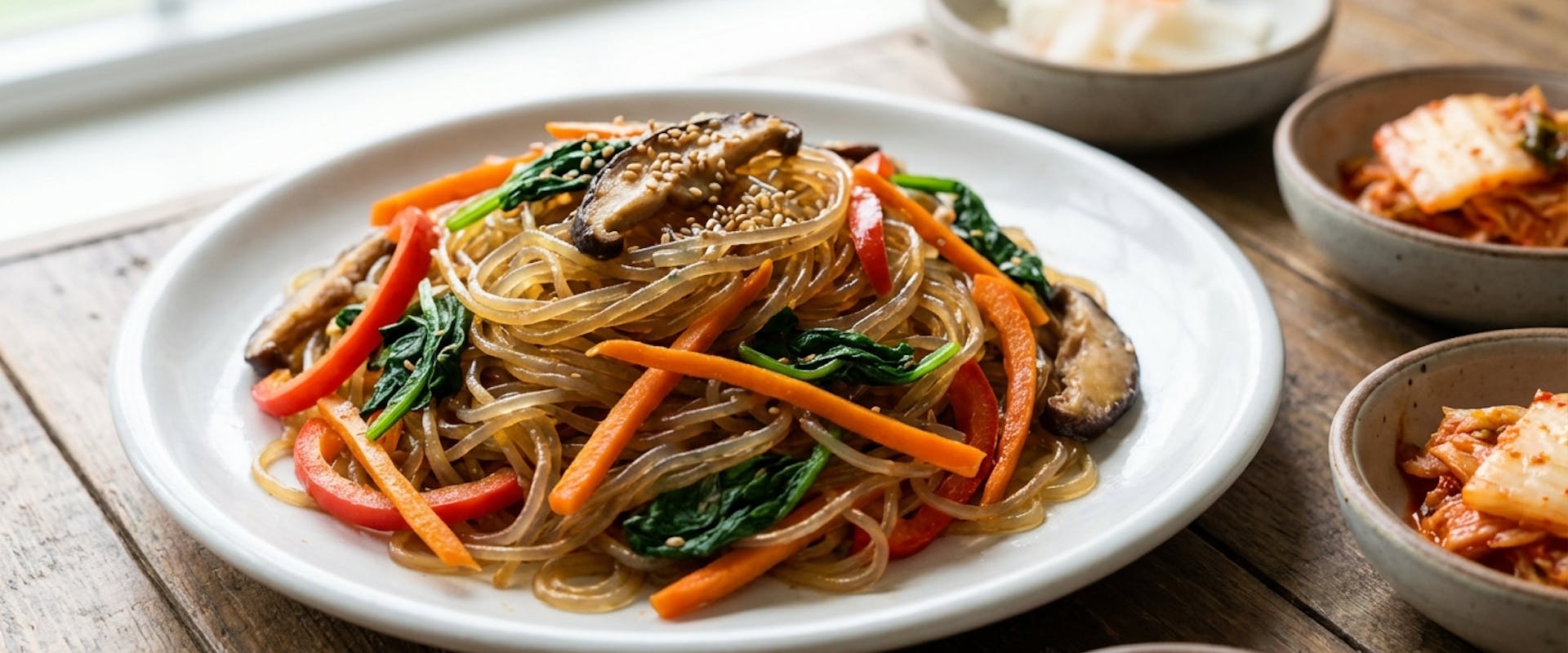

Japchae: Korea's Beloved Glass Noodle Stir-Fry with Sweet Potato Noodles
The glass noodles glisten under the kitchen light, translucent ribbons that catch sesame oil like morning dew. A grandmother in Seoul's Bukchon neighborhood arranges them on a platter with the precision of a painter—each vegetable color deliberately placed, each noodle strand falling just so.
"Japchae is about balance," she explains, her hands never pausing. "Not just flavor, but color, texture, and harmony. Each ingredient must shine, but none should dominate."
This is japchae—Korea's most refined noodle dish, and perhaps its most misunderstood abroad.
The Royal Origins of a Common Dish
Japchae began as palace food in the 17th century during the Joseon Dynasty. Originally served to King Gwanghaegun, the dish contained no noodles at all—just an artful arrangement of vegetables. The sweet potato glass noodles (dangmyeon) were added later, transforming japchae into the iconic dish Koreans know today.
What makes japchae unique among Korean dishes is its delicate sweetness and visual elegance. While many Korean foods celebrate bold, spicy flavors, japchae is subtle, refined, and designed to please the eye as much as the palate.
Understanding Dangmyeon: The Sweet Potato Glass Noodles
At japchae's heart are dangmyeon—translucent noodles made from sweet potato starch. Unlike rice noodles or wheat noodles, these have a distinctive chewy, almost bouncy texture Koreans call "jjolgit-jjolgit."
What makes dangmyeon special:
- Made from sweet potato starch, giving them superior chewiness
- Translucent appearance that makes vegetables visible through the strands
- Absorbs flavors while maintaining structural integrity
- Never gets mushy when properly prepared
- Turns slightly gray when cooked, never pure white
Cooking dangmyeon correctly:
This is where many home cooks fail. Dangmyeon requires specific handling:
- Boil in abundant water for 6-7 minutes until tender but still very chewy
- Immediately rinse in cold water to stop cooking and remove excess starch
- Cut with scissors into manageable lengths (about 6 inches)
- Toss with sesame oil right away to prevent clumping
- Never overcook or they become gummy rather than pleasantly chewy
The texture should be QQ (a term borrowed from Chinese that describes ideal chewiness)—bouncy, resistant to the tooth, but not hard.
The Art of Japchae Vegetable Preparation
Authentic japchae is a rainbow on a plate. Each vegetable is cooked separately to preserve its distinct color, texture, and flavor. This takes time, but the results justify the effort.
Essential japchae vegetables:
Shiitake mushrooms - Sliced and sautéed until deeply caramelized, they add umami depth and earthy richness.
Spinach - Blanched quickly, squeezed dry, then seasoned with garlic and sesame oil. It provides iron-rich green notes.
Carrots - Julienned into matchsticks and lightly sautéed until tender-crisp. They add sweetness and orange color.
Onions - Sliced thinly and cooked until translucent and sweet. They provide aromatics and white contrast.
Red bell pepper - Julienned for bright red color and subtle sweetness. Sometimes yellow peppers are added too.
Wood ear mushrooms (optional) - Add a crunchy texture contrast. Soak dried ones until soft, then slice thinly.
The Beef Component: Optional but Traditional
While vegetarian japchae is common, traditional versions include beef marinated in a simple mixture of soy sauce, sugar, garlic, and sesame oil. The meat is sliced paper-thin and cooked quickly over high heat.
Beef preparation:
- Use ribeye or sirloin, partially frozen for easier slicing
- Cut against the grain into very thin strips
- Marinate for at least 15 minutes
- Cook in batches over high heat—overcrowding creates steam rather than sear
- The beef should have slight caramelization at the edges
The Japchae Sauce: Sweet-Savory Perfection
The sauce is deceptively simple but requires balance. Too much sugar makes it cloying; too much soy makes it salty. The goal is harmony.
Traditional japchae seasoning:
- Soy sauce (for saltiness and color)
- Sugar (for characteristic sweetness)
- Sesame oil (for nutty richness)
- Garlic (for aromatic depth)
- Black pepper (for subtle heat)
The ratio varies by family, but most aim for a sauce that's noticeably sweet but not candy-like, with enough soy sauce to create a beautiful glaze on the noodles.
Authentic Japchae Recipe
This recipe serves 4-6 as a side dish or 3-4 as a main course.
Ingredients:
For the noodles:
- 300g sweet potato glass noodles (dangmyeon)
- 2 tablespoons sesame oil
For the vegetables:
- 200g fresh shiitake mushrooms, stems removed and sliced
- 150g fresh spinach
- 1 medium carrot, julienned
- 1 medium onion, thinly sliced
- 1 red bell pepper, julienned
- 3 cloves garlic, minced
For the beef (optional):
- 200g beef (ribeye or sirloin), thinly sliced
- 1 tablespoon soy sauce
- 1 tablespoon sugar
- 1 teaspoon sesame oil
- 1 clove garlic, minced
For the final seasoning:
- 4 tablespoons soy sauce
- 2 tablespoons sugar
- 2 tablespoons sesame oil
- 1 tablespoon toasted sesame seeds
- Black pepper to taste
The method:
Step 1: Prepare the noodles
Bring a large pot of water to a rolling boil. Add the glass noodles and cook for 6-7 minutes, stirring occasionally. Test one—it should be chewy but not hard. Drain and immediately rinse under cold water. Use scissors to cut into 6-inch lengths. Toss with 2 tablespoons sesame oil and set aside.
Step 2: Cook vegetables separately
This is crucial for maintaining individual flavors and colors.
Heat a wok or large skillet with a little oil over medium-high heat. Cook each vegetable separately:
- Shiitake: Sauté for 3-4 minutes until golden and slightly crispy at edges
- Spinach: Blanch in boiling water for 30 seconds, squeeze dry, season with garlic and sesame oil
- Carrots: Sauté for 2-3 minutes until tender-crisp
- Onions: Cook for 3-4 minutes until translucent
- Bell pepper: Sauté for 2 minutes until slightly softened but still crisp
Set each vegetable aside in separate bowls.
Step 3: Cook the beef (if using)
Marinate beef slices in soy sauce, sugar, sesame oil, and garlic for 15 minutes. Heat wok over high heat with a little oil. Cook beef in batches (don't overcrowd) for 1-2 minutes until just cooked through with slight caramelization. Set aside.
Step 4: Combine everything
Return the wok to medium heat. Add the prepared noodles and pour the final seasoning (soy sauce, sugar, sesame oil) over them. Toss well to coat. Add all the vegetables and beef. Using tongs or chopsticks, gently mix everything together, lifting and folding rather than stirring aggressively. The goal is to distribute ingredients evenly without breaking the noodles.
Cook for 2-3 minutes, tossing constantly, until everything is heated through and well combined.
Step 5: Final touches
Transfer to a serving platter. Sprinkle with toasted sesame seeds and a few grinds of black pepper. Serve warm or at room temperature.
Japchae Serving and Eating Traditions
Japchae occupies a unique place in Korean food culture. It's celebratory food—served at birthdays, holidays, and special occasions—yet humble enough for weeknight dinners.
When Koreans serve japchae:
- Birthdays: No Korean birthday spread is complete without japchae. The long noodles symbolize longevity.
- Lunar New Year (Seollal): Japchae appears alongside manduguk (dumpling soup) as part of the feast.
- Chuseok (Harvest Festival): Families prepare large batches to share with relatives.
- Potlucks and gatherings: Japchae travels well and can be eaten at room temperature, making it perfect for shared meals.
How to eat japchae:
Koreans typically eat japchae as a banchan (side dish) alongside rice and other dishes. However, it's substantial enough to serve as a main course. Use chopsticks to twirl the noodles, catching vegetables and beef together in each bite.
Many Koreans wrap japchae in lettuce leaves with a little rice—creating a ssam (wrap) that combines textures beautifully.
Common Japchae Mistakes and How to Avoid Them
Mistake #1: Overcooking the noodles Solution: Test frequently after 6 minutes. They should be very chewy, almost too chewy. They'll soften slightly when tossed with the sauce.
Mistake #2: Cooking everything together Solution: Cook each ingredient separately. This takes more time but produces superior results. The vegetables maintain their distinct flavors and don't turn into mush.
Mistake #3: Using too much sauce Solution: Japchae should be lightly glazed, not swimming in sauce. Add seasoning gradually and taste as you go.
Mistake #4: Not cutting the noodles Solution: Uncut dangmyeon are impossibly long and difficult to eat. Cut them into manageable lengths after cooking.
Mistake #5: Serving piping hot Solution: While japchae can be served warm, many prefer it at room temperature when the flavors have melded. It's not meant to be eaten steaming hot like many Korean dishes.
Best Places to Experience Authentic Japchae in Korea
While japchae is common in Korean restaurants worldwide, experiencing it in Korea reveals the dish's true potential.
Seoul's japchae destinations:
Traditional markets: Visit Gwangjang Market in Seoul, where vendors prepare japchae fresh throughout the day. The version here is often slightly oilier and more garlicky than restaurant preparations—street food style.
Bukchon Hanok Village: Small restaurants in this historic neighborhood serve japchae prepared according to old palace recipes, with meticulous attention to ingredient quality and presentation.
Modern Korean restaurants: Places like Jungsik and Mingles offer contemporary interpretations—japchae with truffle oil, or plated individually rather than family-style.
Home cooking classes: Several Seoul cooking schools offer japchae classes where instructors teach the traditional separate-cooking method and share family recipe variations.
Japchae Variations Across Korea and Beyond
Haemul japchae (Seafood japchae): Replaces beef with squid, shrimp, and mussels. Popular in coastal regions.
Bibim japchae (Mixed japchae): Tossed with gochugaru (Korean red pepper flakes) and gochujang for a spicier version.
Japchae-bap: Served over rice as a complete meal, popular in Korean Chinese restaurants.
Korean-American japchae: Often includes vegetables like zucchini and uses more sugar than traditional versions, reflecting American palates.
The Philosophy Behind the Dish
What I learned watching that grandmother in Bukchon is that japchae is fundamentally about patience and respect for ingredients. Each vegetable gets individual attention. The noodles are handled gently. The final mixing is done with care.
"In Korea, we say good food requires 'son-mat'—the taste of the hand," she told me, arranging the final platter. "It's not just skill, but the care and attention you give while cooking. Japchae shows this. You can taste when someone rushed it."
This attention to process over speed, to visual beauty alongside flavor, represents something essential about Korean culinary philosophy. Food isn't just fuel—it's an expression of care for those you're feeding.
Bringing Japchae Home
Making authentic japchae at home requires time—plan for at least an hour—but not special skills. The individual steps are simple; it's the coordination that challenges.
My advice: make japchae for a special occasion, not a hurried weeknight. Invite friends to help with the vegetable prep. Put on some K-pop. Make it an event rather than a chore.
The first time you nail the noodle texture—that perfect QQ chewiness—you'll understand why Koreans have been perfecting this dish for four centuries. When the vegetables maintain their distinct flavors while harmonizing in each bite, you'll see why it's celebration food.
And when you serve it on a platter, those translucent noodles catching the light with vegetables arranged in careful color bands, you'll understand that japchae is as much art as it is food.
That's the gift of Korean cooking—the reminder that patience and care create something more nourishing than any shortcut ever could.