
Cheese, Bread, and Mountain Magic: Mastering Khachapuri in the Heart of Tbilisi
The bakery's wooden door swings open at dawn, releasing a wave of warmth into Tbilisi's crisp morning air. Inside, Nino's hands work dough with the same movements her grandmother taught her sixty years ago. She shapes it, stretches it, fills it with cheese that she mixed herself just hours before. This is khachapuri—Georgia's soul food, its national treasure, its edible love letter to the world.
I've traveled to this small nation wedged between the Black Sea and the Caucasus Mountains to understand why this seemingly simple dish—bread and cheese—has inspired such devotion. What I discover is that khachapuri is never simple. It's history, technique, and passion baked into golden perfection.
The Ancient Roots
Khachapuri's origins stretch back centuries, though no one can pinpoint exactly when Georgians first combined their cheese with bread. What's certain is that the dish evolved alongside Georgia's cheesemaking traditions, which date back over 8,000 years.
The name itself offers clues: "khacho" means cheese curds in Georgian, and "puri" means bread. Together, they form something greater than their parts—a dish so beloved that Georgians have created dozens of regional variations, each fiercely defended by locals.
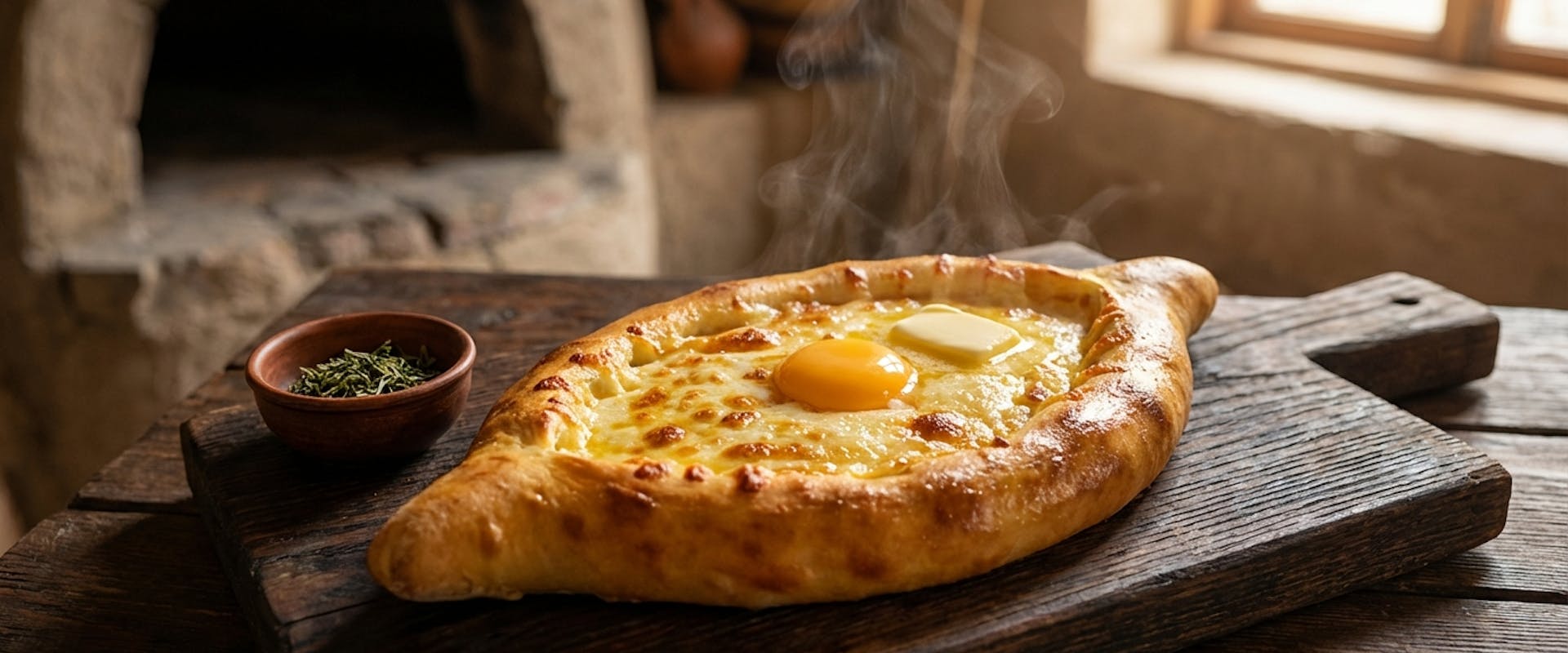
The most famous is Adjarian khachapuri, shaped like a boat with an egg and butter added in the final moments of baking. Legend says this shape represents the boats that brought fishermen home to Adjara, Georgia's coastal region. Whether true or not, the story adds romance to an already romantic dish.
The Morning Lesson
Nino invites me behind her counter, where flour dusts every surface like fine snow. "Khachapuri is about feel," she explains in Georgian, her daughter translating. "The dough must be soft but not sticky. The cheese must be fresh but slightly aged. These things, you cannot learn from books."
She demonstrates her dough technique—a mixture of flour, water, yeast, sugar, salt, and just enough yogurt to add tang. Her hands knead with rhythmic certainty. "Fifteen minutes," she says. "Your arms will hurt, but this is how the gluten develops. No shortcuts."
While the dough rises, we prepare the cheese filling. Nino uses a mixture of sulguni and imeruli—two Georgian cheeses with different textures and salt levels. Sulguni brings stretchiness and mild flavor. Imeruli adds sharpness and moisture. She crumbles them together by hand, adding a beaten egg to bind.
"In Georgia, every family has their cheese ratio," she explains. "Some like it more sulguni, some more imeruli. My grandmother used three parts sulguni to one part imeruli. This is what I teach my daughter."
The Regional Variations
Georgia's regions each claim their own khachapuri style, and trying them all becomes my delicious mission.
Imeretian Khachapuri
The simplest and perhaps most perfect: a round, flat bread stuffed with cheese and baked until golden. No egg, no butter added—just the pure marriage of dough and cheese. This is everyday khachapuri, the version Georgian mothers make for their children's lunch.
In Kutaisi, Georgia's second city, I eat Imeretian khachapuri at a family table. The hostess, Tamara, serves it straight from her wood-fired oven, the top blistered and crispy. When I tear into it, steam rises and cheese stretches in long, satisfying strings.
Adjarian Khachapuri
The Instagram star of the family: boat-shaped, with an egg and a pat of butter added in the final minutes of baking. The technique requires mixing the molten butter and runny yolk into the cheese, then tearing off pieces of the bread boat to scoop everything up.
At a restaurant overlooking the Black Sea in Batumi, I watch the waiter present my Adjarian khachapuri with theatrical flair. "Mix quickly while it's hot," he instructs. The yolk breaks, the butter melts, and the cheese becomes a golden, glossy sauce. I eat it with my hands, as tradition demands, not caring about the mess.
Megrelian Khachapuri
Imeretian's decadent cousin: cheese inside the dough AND cheese on top, creating a double-cheese experience that feels almost rebellious. The top layer browns and crisps while the interior stays molten.
Achma
Layers upon layers of thin dough separated by cheese, resembling lasagna's Georgian ancestor. This is special occasion khachapuri, requiring hours of work and resulting in a dish so rich that small portions suffice.
A Recipe to Remember
Adjarian Khachapuri (Boat-Shaped)
Ingredients:
For the dough:
- 500g all-purpose flour, plus extra for dusting
- 250ml warm water
- 125ml plain yogurt, room temperature
- 2 tablespoons sugar
- 2 teaspoons active dry yeast
- 1 teaspoon salt
- 2 tablespoons vegetable oil
For the filling:
- 400g mozzarella cheese (or sulguni if available), grated
- 200g feta cheese, crumbled
- 2 eggs (1 for filling, 4 for topping)
For topping:
- 4 egg yolks
- 4 tablespoons butter
- Fresh herbs (optional)
Method:
Dissolve sugar in warm water, sprinkle yeast over top, and let stand for 10 minutes until foamy. If yeast doesn't foam, it's dead—start with fresh yeast.
In a large bowl, combine flour and salt. Make a well in the center and add the yeast mixture, yogurt, and oil. Mix with a wooden spoon until a shaggy dough forms.
Turn dough onto a lightly floured surface. Knead for 15 minutes until smooth, elastic, and slightly tacky but not sticky. This develops gluten for the perfect chewy texture. If dough is too sticky, add flour one tablespoon at a time.
Place dough in a lightly oiled bowl, cover with a damp kitchen towel, and let rise in a warm place for 1-2 hours until doubled in size.
While dough rises, prepare the filling. In a bowl, combine mozzarella and feta. Beat one egg and mix into the cheese. The mixture should be slightly wet but hold together. Refrigerate until needed.
Once dough has doubled, punch it down and divide into 4 equal pieces. Shape each into a smooth ball.
On a lightly floured surface, roll one ball into an oval about 25cm long and 15cm wide. The dough should be about 5mm thick.
Place a quarter of the cheese filling in the center, leaving a 5cm border all around. Spread the cheese evenly.
Fold the long sides up and over the cheese, pinching the dough together at the top and bottom to create a boat shape. Leave the center open, exposing the cheese. Twist the pointed ends to seal them.
Repeat with remaining dough and filling.
Place khachapuri on parchment-lined baking sheets. Let rest for 15 minutes while you preheat the oven to 220°C (425°F).
Bake for 15-18 minutes until the bread is golden brown and the cheese is bubbling. The edges should be crispy.
Remove from oven. Immediately crack an egg yolk into the center of each khachapuri (or make a well in the cheese and drop it in). Add a tablespoon of butter on top of the yolk.
Return to oven for 3-4 minutes until the egg white (if any) sets but the yolk remains runny.
Serve immediately. To eat: mix the butter and egg yolk into the melted cheese, then tear off pieces of the bread boat and use them to scoop up the cheese mixture.
Tips for Success:
- Cheese quality matters enormously. If you can't find Georgian sulguni, low-moisture mozzarella works well. The feta adds essential saltiness and tang.
- Don't overbake. The bread should be golden but the interior cheese should be molten, not dry.
- Eat immediately while hot. Khachapuri waits for no one.
- If egg yolk breaks during transfer, don't worry—it still tastes perfect.
- For vegetarians, this is already perfect. For meat lovers, some Georgians add small pieces of cooked sausage to the cheese filling.
The Wine Country Connection
Georgia claims to be the birthplace of wine, with 8,000 years of winemaking tradition. Naturally, khachapuri pairs beautifully with Georgian wine.
At a winery in Kakheti, the country's premier wine region, I learn that Adjarian khachapuri's richness demands wine with acidity to cut through the butter and cheese. The winemaker recommends a crisp Rkatsiteli, a white grape indigenous to Georgia.
We sit on a terrace overlooking vineyard-covered hills, eating khachapuri and drinking wine from qvevri—the enormous clay vessels buried underground that Georgians have used for millennia. The wine is amber-colored, with tannins that grip your tongue and flavors of dried apricot and honey.
"This is supra," my host explains, using the Georgian word for feast. "We eat, we drink, we tell stories. This is how Georgians live."
The Tbilisi Late Night
At midnight, Old Tbilisi's narrow streets fill with young people moving between wine bars and restaurants. I join a group at a late-night khachapuri spot famous for staying open until 5 AM.
The khachapuri arrives on wooden boards, still steaming. Around me, friends share bottles of wine and argue passionately in Georgian. Someone plays a panduri, a traditional string instrument. Another person starts singing, and suddenly the entire restaurant joins in.
This, I realize, is khachapuri's true meaning. It's not just food—it's the excuse for gathering, for sharing, for creating moments that become memories.
The Modern Evolution
Back in Tbilisi's trendier neighborhoods, young Georgian chefs are reimagining khachapuri while respecting its essence. At one restaurant, I try a version with truffle oil and aged Georgian cheese. At another, they've added caramelized onions and wild mushrooms.
Purists might object, but these innovations prove khachapuri's versatility. The dish can evolve while maintaining its soul—as long as there's good bread, good cheese, and the spirit of Georgian hospitality.
The Lesson of Khachapuri
On my final morning, I return to Nino's bakery. She's training her granddaughter now, a teenager named Mariam who will become the fourth generation to make khachapuri at this location.
"Will you change the recipe?" I ask Mariam.
"Never," she says firmly. Then she grins. "But maybe I add something new beside it. Tradition and innovation—both are Georgian."
Nino nods approvingly and hands me a warm Imeretian khachapuri wrapped in paper. "For your journey," she says.
I carry it through Tbilisi's streets as the city wakes once more. The bread is still warm against my chest, and I think about all the hands that shaped it—Nino's grandmother's hands, Nino's hands, Mariam's hands. Generations of knowledge baked into something as simple and profound as bread and cheese.
Some dishes feed the body. Khachapuri feeds something deeper—the human need for comfort, for tradition, for the sense that we belong to something larger than ourselves. That's why this cheese bread from a small Caucasus nation has captured hearts worldwide.
Make khachapuri this weekend. Invite friends over. Pour some wine. Share stories. That's how Georgians do it, and they've been perfecting the art of gathering for 8,000 years.
The dough is ready. The cheese is waiting. And somewhere in Tbilisi, Nino is already shaping tomorrow's bread.